

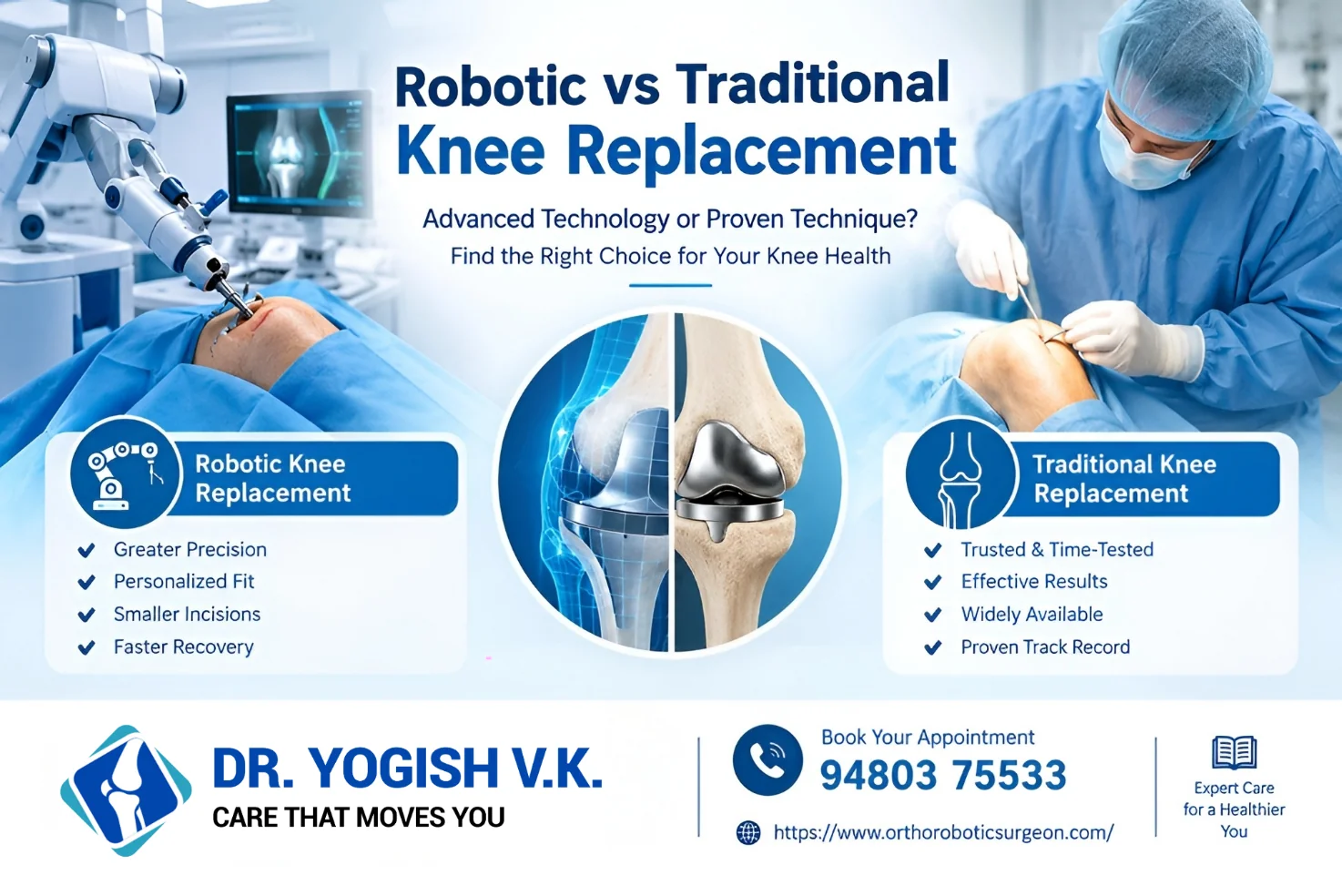
Robotic-assisted knee replacement uses a 3D plan built from scans of your own knee, and the robotic arm holds the surgeon to that plan within a fraction of a millimetre. Traditional knee replacement uses mechanical guides and the surgeon’s judgement, refined over thousands of cases. Robotic surgery is measurably more accurate in positioning the implant. Whether that accuracy changes how your knee feels in ten years depends on your knee, and for some patients, traditional surgery remains the better choice. This article explains which is which.
What actually differs between the two
| Aspect | Robot-assisted | Traditional |
|---|---|---|
| The plan | Built in 3D from your own scans before the first incision, and adjustable during surgery. | Formed during surgery using mechanical jigs, anatomical landmarks and the surgeon's experience. |
| Implant position | Held to sub-millimetre tolerance, confirmed by the system in real time. | Guided by alignment rods and visual assessment, verified by the surgeon's eye and feel. |
| Soft tissue balance | Ligament tension measured numerically through the range of movement. | Balanced by feel, with releases made as the surgeon judges necessary. |
| Bone removed | Only what the plan specifies. | Slightly wider margins, because the jigs need clearance. |
| Operating time | Often modestly longer, particularly the planning stage. | Generally shorter. |
| Cost | Higher: platform, planning time and single-use instruments. | Lower. |
One point worth stating plainly, because it is the question patients most often ask nervously: the robot does not perform your operation. Dr. Yogish performs every step. The system holds his plan to a standard of accuracy the human hand alone cannot sustain, and it stops the instruments straying outside the planned boundary. Judgement, decisions and the operation remain entirely his.
What the evidence actually shows
This is where honest reporting matters, because the marketing around robotic surgery has run some distance ahead of the published research.
Well established
Robotic assistance improves the accuracy of implant positioning and limb alignment, and reduces the number of cases that fall outside the intended target. This is consistently demonstrated and is not seriously disputed.
Reasonably well supported
Several studies report less early post-operative pain, reduced soft-tissue trauma and slightly faster early recovery milestones in robot-assisted cases.
Not yet proven
Whether that accuracy produces better function, higher satisfaction or longer implant survival at ten, fifteen or twenty years is still being studied. Knee replacements already last a long time, so proving an improvement takes a long time. The expectation is reasonable; the proof is not yet in.
Where robotic assistance genuinely helps
- Significant deformity: where the leg has drifted noticeably into bow-leg or knock-knee, restoring alignment accurately is harder and the planning genuinely earns its place.
- Younger, more active patients: a patient in their fifties may need the implant to last thirty years or more. Accuracy of alignment is thought to influence how long an implant survives, so precision is worth more here.
- Partial (unicondylar) knee replacement: when only one compartment of the knee is worn, a partial replacement preserves the rest of your own joint, but it demands precise positioning, and robotic assistance is particularly suited to it.
- Unusual anatomy or previous surgery: hardware from an old fracture, or bone shaped unusually, makes conventional jigs harder to place reliably.
- Predictability: because every cut follows a plan verified in real time, the surgical team works to a consistent target rather than adjusting on the fly.
Where it makes less difference than you might expect
In a straightforward knee (modest deformity, good bone quality, an older patient with ordinary activity demands), an experienced surgeon using conventional instrumentation achieves excellent, reliable results. Knee replacement was a highly successful operation long before robots entered theatre. The accuracy gain is real, but the practical difference you would feel walking to the shops is likely to be small.
Robotic assistance also does nothing to change three things that matter enormously: the skill and case volume of your surgeon, the suitability of your implant, and how diligently you complete your rehabilitation. A robot cannot rescue a poor plan, and it cannot do your physiotherapy for you.
When traditional surgery is the better choice
There are real situations where Dr. Yogish would recommend conventional instrumentation, and it is worth saying so clearly.
- Where existing hardware interferes: certain retained implants or plates from previous surgery can interfere with the tracking arrays robotic systems rely on.
- Where additional imaging is unwise: robotic planning requires pre-operative imaging that carries its own small radiation exposure. In some patients that trade-off is not worth making.
- In urgent or complex trauma: a fracture around the knee or an urgent revision may not allow time for the planning stage.
- Where cost is a real constraint and the benefit is marginal: where the additional cost would genuinely strain a family and the clinical benefit in that particular knee is marginal, recommending it anyway would be wrong. An excellent conventional result is far better than a robotic operation a patient cannot afford to recover from properly.
Any surgeon who tells you robotic assistance is right for every patient is selling technology rather than practising medicine.
What matters more than the robot
| What to ask about | Why it matters more |
|---|---|
| Your surgeon's volume | How many of this specific procedure does the surgeon perform each year? Volume correlates with outcomes more strongly than any single piece of equipment. |
| Implant choice | Matched to your age, weight, activity and bone quality. A well-chosen implant placed well beats a premium implant placed poorly. |
| Your rehabilitation plan | Structured physiotherapy determines a large part of your final range of movement and strength. This is the part you control. |
| Honest assessment | Whether the surgeon has told you clearly what surgery will and will not fix, and whether non-surgical options were properly considered first. |
How the decision is made in practice
At your consultation Dr. Yogish reviews your X-rays and scans with you on screen, shows you exactly what is worn and what is intact, and explains the full range of options, including the ones that avoid or delay surgery altogether, such as limb alignment surgery or cartilage restoration in suitable patients.
If replacement is appropriate, the discussion covers whether the whole joint or only one compartment needs replacing, which implant suits your anatomy and activity, and whether robotic assistance will make a meaningful difference in your particular knee. You will be told plainly if it will not.
The short answer
Robotic-assisted knee replacement is more accurate, and that accuracy matters most in complex knees, younger patients and partial replacements. Traditional knee replacement, in experienced hands, remains an excellent operation that has given millions of people their mobility back. The better question is not which technique is superior in the abstract, but which is right for your knee, and that is answered by examining your knee, not by reading an article.